Still Developing

" A lot of my enjoyment of photography comes from learning. This is typically done through talking with others, reading books, magazine articles, blogs, etc. Part of the balance of having so much good information available (especially the writings that people make available for free online) is to contribute back by writing anything that I learn or experience. If you get something out of this great. If you care to comment to correct my many mistakes, I would greatly appreciate it. Landscape photography can be a lonely occupation but the conversations we have more than make up for that. "

Saturday
27th June 2009
3 Comments
Last: 20 hours ago

Thinking About Seeing and Seeing Without Thinking

Obsessing as I am about composition at the moment, I thought it a good idea to write a few of my ideas down, hoping that I can bash them into some sort of logical submission.

It was David Ward's epic post about originality that started my current thoughts. The general background was the phenomenon whereby many photographers visit places they have seen in photographs before and take the same view or visit the seaside at sunset and construct very similar photographs that they have seen in magazines. It made me wonder whether there was something subconcious and/or unintentional happening. I had a feeling that it could be to do with how we 'interpret' a scene in relation to our previous experience and our preprogrammed understanding of the world. i.e. Most people only interpret the view that they have in front of them, very few people actually see it.'tree, stream, mountain, grass' combined with some emotive terms such as 'stark tree','fiery grass', etc.

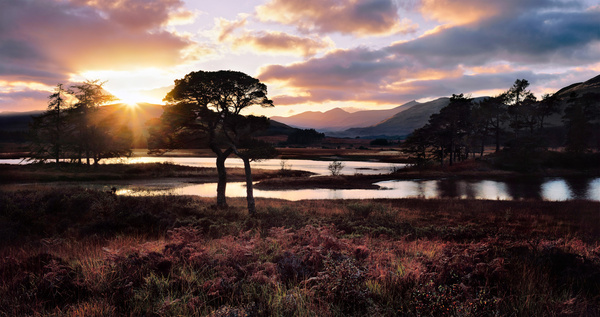
Let me explain what I mean by "interpret". Given a view of the classic dead tree on Rannoch Moor, most people will survey the scene and their subconcious will filter the visual input and pass the following information on to the brain

.. tree .. pointy hill .. rocky stream .. boggy grass .. etc.

The problem with interpretations is that they are informed by our history and our culture and they are so strong that they overpower the actual scene we were looking at. In my post I made a comparison with how we read words on a page. Firstly, we don't look at letters much; when we read a sentence, we look at word shapes made by ascenders (flk), descenders (jgy), the holes that o's, e's and d's for, etc... and 'guess' what the word is. We also don't actually look at every word if we can guess what the rest of the sentence says. So given a paragraph in a book, we scan these shapes and use our pattern recognition skills to get at the core information.

So what happens when we do actually read a word. I imagine most of us have looked at a word for long enough to start doubting its spelling or even it's meaning at some point. When we really look at a word for some time, our interpretation mechanism becomes suppressed and we start to see the individual letters and pairs of letters. The problem is, we probably have never done this before (not for a long time anyway) and so the word looks 'new'. We have a cognitive dissonance between the fact that we know the word very well combined with the fact we are really seeing it for the first time.

This disabling of the 'interpretive' part of our brains is an important part of our artistic abilities. To give you an idea how important, you need to read some old books on art appreciation and how artists have gradually moved along a path from symbolic representation. Well I've done it for you to save you a little time. The key section that made me really click was in Pliny's history of art where he recognises Nicias as the first person to paint light and shade Chairascuro) which means that before this point, no-one had conciously realised that a solid had different brightnesses when exposed to light. It's difficult for us to understand that people did not interpret vision in the same way that we do now. They literally could not see the view in front of them, they were only able to interpret it. When they saw a view or person, their brain processed the view and decomposed it into it's constituent parts and then they drew their artwork from these parts. Some of the techniques we learn in drawing as children would be revelations to our ancestors. Of course it could be that these acient ancestors knew all about shade and light, perspective and foreshortening but just chose to ignore them all as part of their own 'personal visions' ;-)

How is this relevent to photography? Well we're lucky that our cameras do the drawing for us so all we have to do is see the opportunity and realise it. The problem is that we still need to see the opportunity ourselves but how can we do this if we can't 'see' the wood for the trees (It might just be possible that the reason people take so many photographs with digital cameras is that they are not able to see the result until after it has been taken? They are effectively shooting partly blind)

However, just like when we look at a word for too long it stops being a symbol and you start to see the letters and shapes of the letters, when we are out in the field for a long time, we gradually stop seeing the symbols - sun, rock pool, sand, reflection - and will hopefully start to see the real projected space of things and the real colour, like how the sand shifts colour in the shadows and how the curves of two pools meet each other.

A few friends, including Jason Theaker and Rob Hudson, have pointed out that when they are 'in the zone' taking photographs, it is akin to a form of meditation. This is something I have also felt, not every time but when I do get the feeling I start to see opportunity everywhere. It's like the world was some unfathomable whole and gradually the puzzle parts become clear and the solutions available (even if not manageable). This 'opening' of your perception is a state of mind that should be our goal. Marcel Proust said "The real voyage of discovery consists not in seeking new landscapes but in having new eyes." and it is these new eyes that we can unveil by looking harder or more importantly, "looking without thinking". Another great quote from English Writer G.K. Chesterton "If you look at a thing 999 times, you are perfectly safe; if you look at it for the 1000th time, you are in danger of seeing it for the first time.".

This state, sometimes called mindfulness, is fairly well known and there is book called 'The Tao of Photography' that, judging by the first chapters which you can read on google books, will make for an interesting read on the subject. Although it only talks about Mindfulness in a couple of places, the whole concept is very much oriented around the Zen practise of just 'being', just 'looking. (seeking mindfulness however is not mindful - damn!).

So what we, as photographers, do when we are in this altered state is to capture a view of our environment that the general viewer would overlook. If we can overcome our initial gestalt perceptions, we bring a new way of seeing to our audience.

However, we can also use our new found knowledge of how perception works to create better works of art. There are various perceptive capabilities that our eyes/brain have that allow us to infer extra information from the view in front of us. Most of these capabilities are to do with making decisions on insufficient information - for instance, we will infer the remainder of a shape where only it's edge is showing (obvious survival benefits here - human: "ooh is that a bear behind that tree!", bear: "gestalt, schmestalt!... dang"). I hope to expand on how you may use knowledge of your viewers perceptive abilities to create better compositions over the next couple of weeks. For now, I'll leave you with an interesting observation about leading lines in photography.

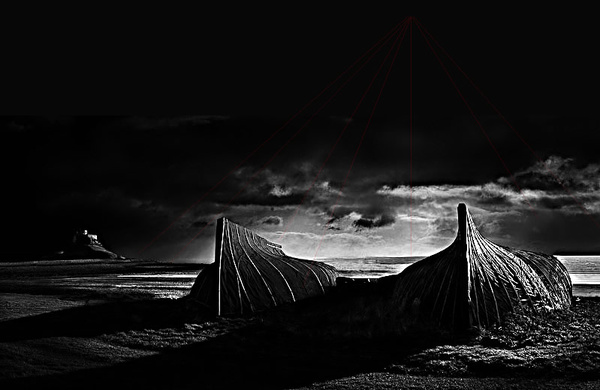
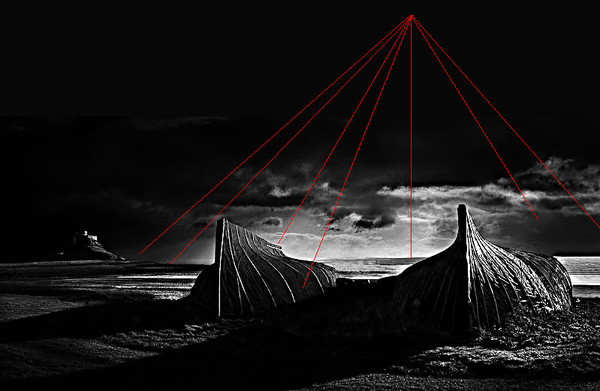
When viewers 'scan' our pictures, they do not do so in a linear fashion i.e. their eye does not follow a linear path across a picture, absorbing content as it goes. Instead, our eye jumps in small movements called 'saccades' and then rest for a moment if there is something 'interesting'. The resting points are called 'fixations'. It turns out that our eyes 'cannot' smoothly scan from one part of a picture to another. However, if there is a line feature in our picture, it gives our eye a continuous progression of fixation points to follow and, subconciously, our eye prefers to follow this than to skip onto another 'unknown' part of the picture. Also, when your eye is in its 'saccade' state, your visual system is suppresed (although not completely shut down) so that you don't really 'see' anything in between fixations.

Another perceptual nuance is our ability to 'fill in the blanks' (Gestalt Theory' law of continuity) when we see a broken shape or line e.g. if we were to see a partial or broken line, our brain creates virtual 'filler material' where the gaps are to produce a full shape, also strongly preferring primary shapes, lines, circles, triangles...

Combining these two perceptual features together, we can start to understand just what leading lines in pictures are doing. The core 'sharp' focus are, our fovea, only covers a couple of degrees and saccades can typicalluy cover about 15-20 degrees but typically only traverse about 4 degrees. So our eye either takes a big jump across a section of the picture, not seeing anything in between (Try viewing this video and try really hard to count the number of ball passes.. once you have done so, click here), or they can follow a line in the picture (real or gestalt) and absorb the features along that path. When our eye gets to the end of a line, it has to 'jump' somewhere, either back to something it saw on the line previously or possible to an area of high contrast or interest - remember that your eye does not see detail outside of the fovea so unless you have some strong feature in your picture, your eye/brain won't have anything to be attracted to.

So we can now explain leading lines, strong fixation points; we can even assume that those 'dead' areas people talk about in critiqueing pictures are where the eye can't gets to via a leading line and that have no strong feature to trigger a large saccade to.

Obviously we wouldn't want to be thinking about all of this as we are looking for pictures, but it may be useful to bear this in mind when we are doing our final checks. You should try to see the picture as if for the first time and follow the suggested lines. Do they lead out of the picture or do they keep the flow of the eye moving within? When a line ends, is there anywhere for the eye to go? Does your eye get caught in one part of the picture?

The subject of perception and art is one that is fascinating and slightlty scary. As much as I want to know more about how the eye works, I really don't want to 'pollute' my mindful eye. All of this is interesting knowledge and is of some use when critiqueing pictures but our ultimate goal should be to allow these concious thoughts about composition and balance to become part of our subconcious, allowing our own impulses to mingle with our compositional skills to create somethig uniquely personal.

system asset

Saturday
20th June 2009
2 Comments
Last: 7 days ago

Half Shade and Timing

When I started using my large format camera, one of the early tests I made was on the effect of shade on the look of pictures. I had taken a few pictures with my digital camera where the foreground was in partial shade and was intrigued by the how it gave a depth and colour that was surprisingly vivid. When I was taking one of my first large format shots I decided to try a couple of extra shots just to see how much difference getting that critical moment made.

My instinct told my that the best momet to take the picture was just as the shade was opening up and with a sunlit background. Well you can see the results for yourself. The picture taken just before this critical moment is dull and lifeless; the picture taken just afterward is starting to become burnt out and has lost colour and depth; the critical moment gives a picture that has soft, open colour.

The reason for this, as far as my understanding of lighting is concerned, is that when you you have light transitioning from behind the cloud you have a combination of diffuse light and direct light. During this time you have the opportunity to balance those two sources of light, just like you would do manually in a lighting studio. Typically, the background will benefit from direct or only slightly diffuse sunlight because the harsh lighting doesn't have as great a negative impact at a distance.

Two of my favourite photographers have said that experience in a photography studio gave them an insight into how lighting works and this knowledge was particularly useful in the field. We don't have control over lighting sources in nature but learning to predict the different effects the atmosphere can have on our primary spotlight can help us make the most out of our subject matter.

I'd be interested in hearing any other observations about how the to use the atmosphere to create stronger pictures.

system asset

system asset

system asset

Saturday
13th June 2009
20 Comments

Last: last week

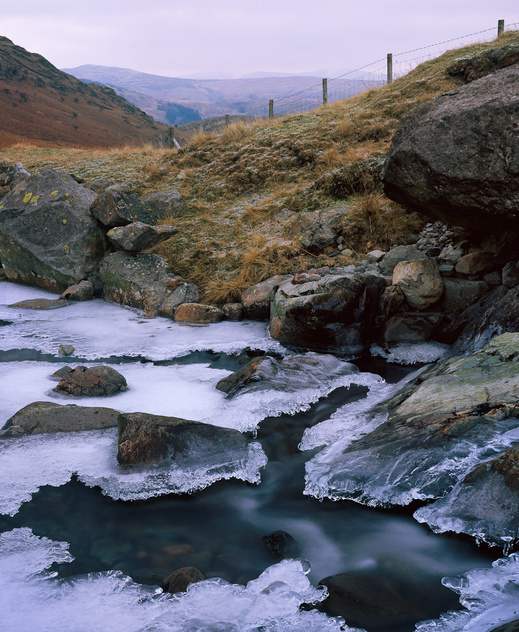
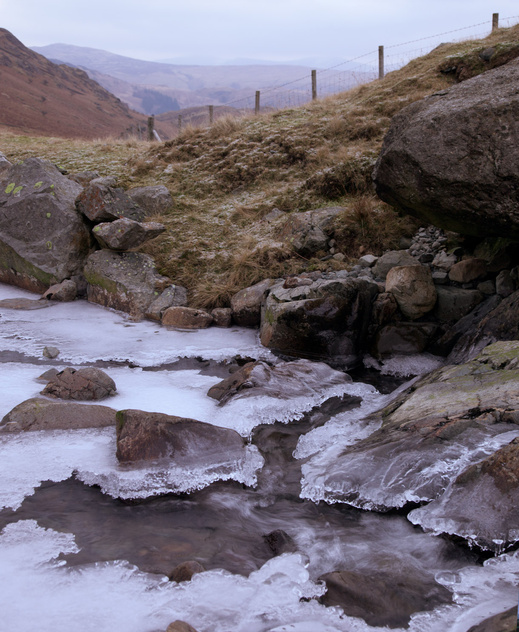
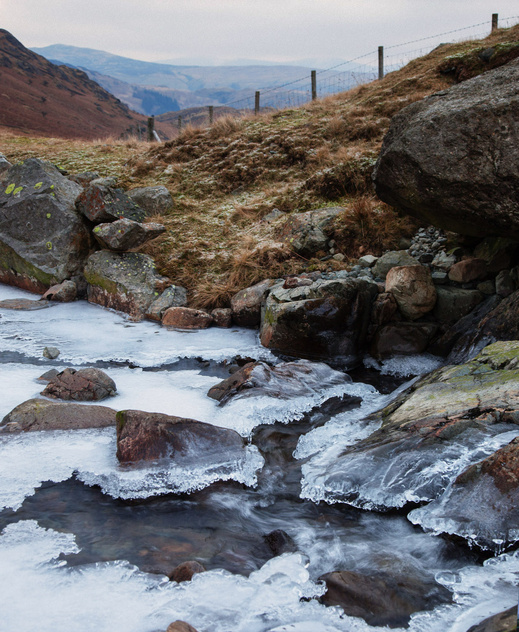
Fuji Velvia, Provia, Astia, and Pro160

One of the things I have been trying to learn over the last two years of using film is how the different types (at least quickload types) render colour and tone? Which film should I use in which circumstance and which film should I just ignore. I've mostly been using Velvia and Provia but recently I picked up a box of Pro160s (prior to my Northumberland Light and Land trip) and a few boxes of Astia from the US (at considerable cost unfortunately).

The majority of landscape photographers that I admire use Provia and Velvia (sometimes 100) and Provia only infrequently. However all of the 'art' landscape photographers use Pro160s (or Portra) and possibly the less saturated transparency films like Astia. I don't like taking things for granted though, I'd rather see for myself (even if the results are as expected). So, over the last few months, every time I have had the opportunity I have taken a picture with alternate films of subjects that I hope will show some of the differences (especially at extremes of colour and light). In this post I'll show all of the pictures and discuss my interpretation of what I am seeing. I'll also try to emulate each film by adjusting the results to compensate to find out if I can make Provia look like Astia or Pro160 look like Velvia (as if!)..

Lets take a look at Velvia and Provia to begin with as these are the most commonly used transparency films in large format. I'm using the new version of Velvia and most of the pictures have been taken at the rated iso 50. You can click on any image to get a larger view.

system asset

This is a shot I took in the Yorkshire dales with scattered clouds on a blue sky. This isn't taxing either film particularly. The colours are fairly low in saturation and the contrast isn't extreme. The differences here are fairly subtle but here are the main ones

  • The overall look of the provia version is fairly cyanic
  • The provia is less saturated than the velvia.
  • The whites of the clouds look slighly magenta on the velvia version.
  • The grass in the velvia seems to have a shift to blue/cyan and is darker - definitely more realistic grass in the provia

Interestly we see two different effects here. The overall cyan cast and yet the grass is definitely towards the orangy red. To correct the Provia you would probably have to add a warming filter and then cool the greens back down again.. However, having tried this I then ended up with muddy blues on the provia transparency. The relationships are complex even here.. Overall however, Velvia seems to separate out the magenta, blue and green components of the picture and the greens > blue, whites > magenta. Provia has less colour separation and has an overall cyan tinge, however the greens seem to be least affected by this; Provia has little of the intense sky blue separation seen on Velvia.

system asset

This is taken on a very hazy spring day in Scotland where there was a strong visible blue/cyan cast to the world. Because we're operating in a smaller spectrum of colour, we start to see the difference in film behaviour more strongly. The main differences..

  • The provia is intensely cyanic
  • The velvia has offered a fairly neutral colour although does carry an overal very slight magenta colouration
  • The yellows in the provia are almost acid wheras Velvia has given a rich orangy yellow (more natural to this lichen)

This time the Velvia would be the obvious choice to render a colour accurate picture in these conditions (which goes against instinct). Both films behave sensibly in the shadows (i.e. no extraenous cast)

system asset

Here we have some very low contrast levels on a dawn on Rannoch moor about 15 minutes before dawn. The contrast range must have been only about +/- 2 stops at most (although some patches of dark probably go -3+). I exposed the frames about mid way so the highlights are a nice +1 2/3. So, to the differences

  • The provia shows a strong cyan cast again, especially in the highlights. However, I think I can see a magenta tinge to the shadows.
  • The Velvia is strongly magenta in the midtones and highilight but with a shift to green in the shadows,

Here is a version with the Levels adjusted to fix the black points..

system asset

Here you can see the colour cast in the shadows a lot clearer.

system asset

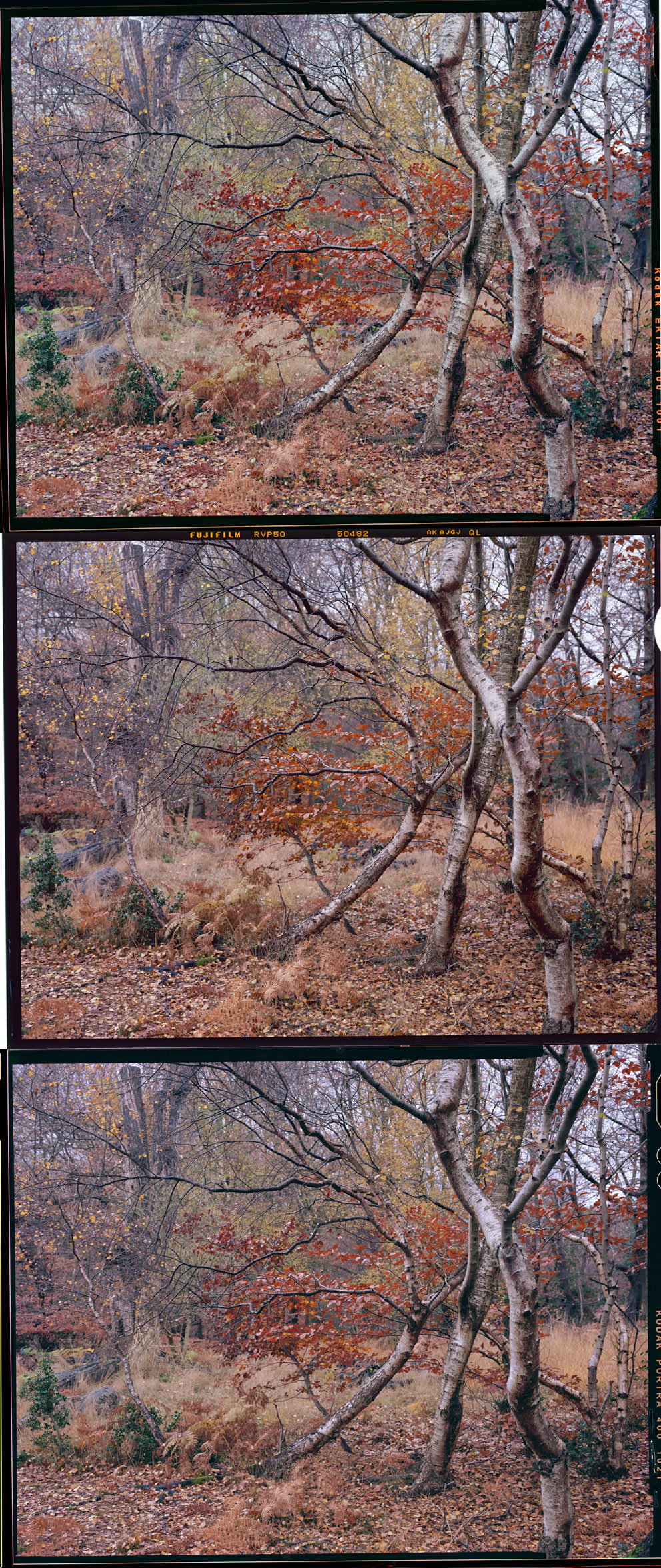
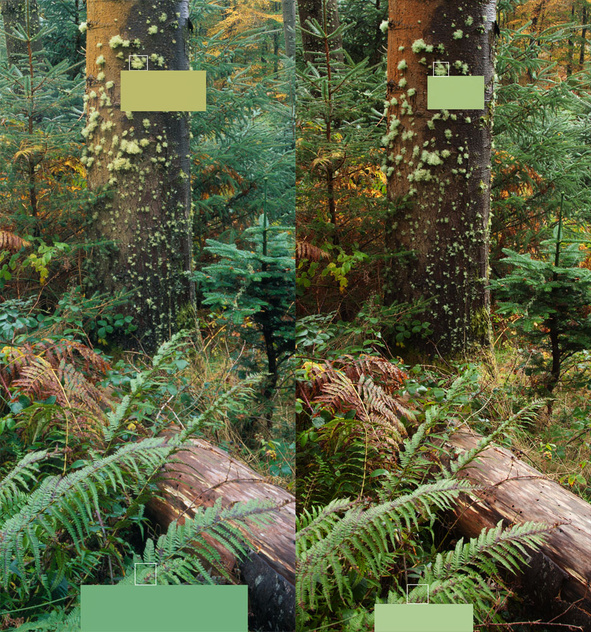
Here is a picture full of bold colour. It also shows some interesting ways in which Velvia treats reds and greens. The reds in particular are increased in contrast. If you look at the red leaves, the slighly darker colours in the red leaves are much darker in the velvia transparency. The digital file of this picture shows a lot more yellow in the ferns and the provia is closer to this - I would probably say that the provia is closer to the actual colour. The digital picture also shows that the reds don't go as dark as in either the velvia or ther provia. I think red response falls off very rapidly so reds will tend to be either dark or light, maroon or intense pillar box red. So in summary

  • On velvia reds roll of in lightness very quickly, dropping to maroons
  • Velvia has strongly saturated shadows as opposed to provia where greens can become quite muted in the shadows and also show a warmish shift..
  • Definitely more open shadows in the provia

system asset

Here is a well exposed picture (at least for me) and it doesn't show any extreme casts. The provia cyan is till there and we can see the warm greeny blues in the vegetation shadows. The dark red ferns in the provia are almost maroon wheras in the velvia they are a warm orange. Definitely a win for Velvia here..

system asset

Here we can see the classic velvia sunrise colouration. Provia is behaving very differently here.. It has an intense cyan colouration which needed a strong red filter to bring things back to neutrality. Unfortunately a basic red filter also screws up white balance and destorys some of the green colours. The Velvia has created dark magentas in the sky wheras Provia has turned a deep midnight blue. The truth, again, was somewhere in the middle.

Again though, the films are behaving strategically - colour by colour. This isn't just a magenta cast and stronger contrast. Almost all colours and shades have their own independant colouration. This is really what makes velvia so special, there isn't a simple conversion you can apply to a neutral image that will reproduce it. Velvia does respond well to a cyan cooling filter when you have intensely coloured light like this. I've tried applying the appropriate colour changes to the different parts of the image knowing that theoretically it's possible to convert a Provia slide to a Velvia slide. However, it isn't possible and I think I know why.

Quick side trip into destructive transformations. If we have three colours.. Blue, Green and Yellow and we take two theoretical films.. The first (A) has an affinity for blue and greens tend to look blue but yellows look ok.. Our second film (B) has an affinity for Yellow and greens tend to look yellow but blues look ok. So .. if we wanted to transform film A into film B, what colour do we convert Blue into? Green or Yellow?

Anyway, back to film comparisons..

system asset

Here is a photo taken on a cool morning in March. We've got no real surprises on the provia and velvia front but we're introducing Pro160 now. As far as I can understand it, negative film cannot be consistently converted as the different orange masks vary or development is more sensitive or something (someone could explain?) but I've kept the conversion parameters in Silverfast consistent so hopefully we have a representative of what could happen. Pro160 is obviously a lot less contrasty but one of the interesting things we can see here is the separation between the cyan and magenta combined with an overall yellowy cast..

system asset

More Provia/Velvia comparisons.... nothing new here (unless somebody can see something interesting?)

system asset

And here is an example of how different conversions of Pro160 can be dramatically divergent.. I obviously need help (DAV!!)...

Astia!

And so on to Astia.. I bought three boxes and an excessive price from Badger Graphic in the US (it isn't available in Europe any more) and went through a box in comparisons whilst on a family holiday in Northumberland. Well, my opinions are mixed but I'll start showing you the raw material

Well start with a comparison between Velvia and Astia (with the original digital file for comparison)

system asset

The first thing we see is that the Velvia is more colour accurate than the Astia (compared with the digital anyway). This was quite a surprise! I expected, with all I had heard about Astia, that it would be very close to life like. In fact it seems like, with vibrant colours at least, astia has a strongly unsaturated look and feel with a slight yellow cast. Another surpsise is that it seems to have a magenta cast in the shadows (unless Peak Imaging are having ph problems). That said, I like the pallete of it. I like the way it has created a water colour like feel. I think that where Velvia separates greens and magentas strongly, astia separates yellows and blues (just a theory yet). Here is another comparison of the whole sky once the sun had risen.

system asset

oops... I made a velvia/provia comparison and forgot the astia.

system asset

This picture at least shows the green shadows in Velvia and the Magenta'ish shadows in Provia

system asset

Quite a green comparison here. We can see the classic bluey greens of the Velvia and the Astia has a lack of saturation in the green although keeps a strong yellow component. This makes for a dried out, desert feel to grasses (compared to the rich lushness of the velvia look - which is probably why summer greens with Velvia end up wierd; combine the natural increased blue component with summer foliage and the bluey cast of green colours and you get something quite alien.

system asset

flowers! Here is a nice subtle shot to compare responses. I can see the yellowy cast in the astia, the blue greens in the velvia and a cyan in the provia. The colour in the digital looks a little too yellow from what I remember which I see quite often in digital greenery (obviously too many green sensors).

system asset

These huts show some wierdness in the blues.. I know the tarpaulin wasn't greeny blue of the digital and it wasn't the royal blue of the velvia. In this case the astia seems most accurate although the magenta shadows don't look realistic - then again neither are the green shadows in the Velvia.

system asset

This is a comparison across all of the films I've been using. You can see quite clearly here the dramatic separation of blue and magenta cast of the velvia. The provia is looking pretty neutral if slightly cool. The Astia has the same 'parched summer' look with some magenta in the dark areas (check the water colour). Pro160 looks quite good but I can never get a nice compromise between too much green or too much magenta - here I've gone slightly magenta in the mid tones. Finally, the digital just looks a little alien; the blue clouds and intense yellowy green shadows (in the grass) don't look natural to me, although it does get the water and beach pretty spot on.

system asset

This shows the magenta or green shadows in astia and velvia and the yellow in the astia overall. It also shows the increased dynamic range of astia in comparison to velvia. Finally it also shows the horrible peachy sky that you get with digital combined with the hideous yellowy greens yeuch...

system asset

Here is a dramatic image showing the magenta/green differences between astia and velvia. It also shows that astia has got the sky pretty right. Look at the greens though! Velvia looks spring like whereas the Astia looks like the end of summer..

As the sun goes down...

system asset

This one confused me.. The sand doesn't change much between shots but the skies are sooo different (note that the digital ewas taken in shade so it isn't a good match for the others really). I can't manage to discuss these pictures too much as I'm all analyticaly burned out... I'll leave this and the final picture for you to tell me what you see.. These last transparencies are very underexposed (the velvia not so much so).

system asset

I hope that leaves you with a good impression of some of the differences between the main large format films being used by landscape photographers in the UK. I would like to try out some Kodak film at some point too. As a final point, it has been said that some of the colour casts I'm seeing may be to do with my processing lab (Peak Imaging) not having their developer at a consistent pH. The next test I am going to try is to send a few of the same shot to different developing labs in the UK. Hopefully this should provide a measure of how consistent we can expect lab processing and how to recognise what is film colour influence and bad processing colour influence.

Please help me by providing your own interpretations of what you see here. The more I can get to know the characteristics of these films, the better I can predict what will happen when faced with a new picture.

system asset

Wednesday
20th May 2009
6 Comments
Last: 3 weeks ago

Family Holiday in Northumberland

Going on a family holiday is a stressful time for a photographer; Working out how to balance time between family and photography can often lead to unstaisfaction for both parties. In addition to that, quite often family holidays tend to occur in the summer months when sunrise times are particularly unreasonable, there are too many people around and clear blue skies (if they happen) are fine for non photographers but useless for us. So, how can you make the most of this time? Well, the best thing to do would be to put down the camera and just enjoy the experience, but as most of us are obsessive compulsives by nature I think this is probably unreasonable. My personal solution, whilst on a family trip to Northumberland, was to bite the bullet and get up stupidly early for half the mornings and then explain to the family that I would be dissapearing about 8.30 to get a few sunsets in. If I got up at 3.30 I could be back in bed for 5.30 and get the second half of my 6 hours sleep!

So how did this work in Northumberland? Well the one disadvantage of this is that you don't get much time to scout out areas so instead of trying to cover as much ground as possible I decided to stick to one area, which was easily accessible by car, and work my way around it. I decided to only visit the end of the Wynding and Budle bay as the sun set just opposite Budle bay to the left of Holy Island (see evening shot in gallery for example - link at bottom of this post).

The Sunsets

Budle Bay is a mile walk from the Wynding down to Budle and back again wth a few areas of geological interest between. The first evening I walked fairly aimlessly around the dunes in Budle and was dissapointed that the sand was mostly trodden over and the pictures I took were a little disappointing. I did manage to get a photo of Bamburgh's famous fighting caterpillars though! (see below). It was only on the final night that I found a clean area, a subdued sun and a composition that gave me the feeling of the area (See picture below).

The main issue I was getting was footsteps in the sand limiting my options. However, on one evening the wind was blowing a gusty 20mph and had managed to shift quite a bit of sand against some of the nice rock features just past the end of the Wynding. The mini sand dunes that were created reminded me the larger African dunes and I decided to try to create something that brought out this foreign feel. I had to work very low (burying my tripod in the sand in an attempt to get the rocks above the horizon) and was covered in sand at the end of the process but I hope the result works.

One of my goals during the holiday was to use less film, to try to capture each shot in only a single sheet. This, combined with my other goal of comparing Astia, Velvia and Provia (to be featured in my next blog entry) meant I only had time to work with two compositions and I think I slightly overexposed the first and underexposed the second - ah well, these are the lessons I wanted to learn by only taking one shot..

The Mornings

I had a bit of success on the second of my morning outings where I was rewarded with a beautiful orange, blue, yellow pink and purple pre dawn glow. Unfortunately I couldn't find anything to create something with a strong compositional structure and ended up using the shapes of the rocks to introduce some visual movement through the frame. I suppose I could say that "It's the colour stupid!" but that would be a cop out - I really just let nature spray pretty colours onto my film.

The Family Outings

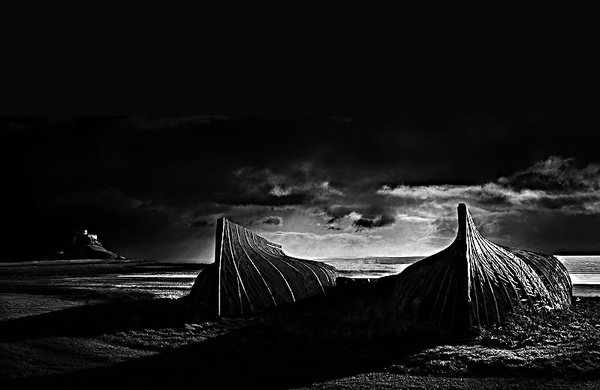
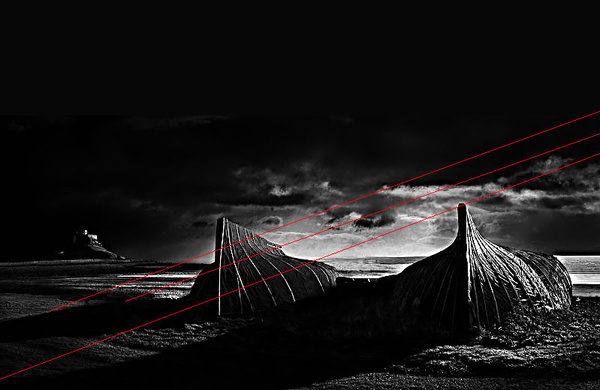
I did take the camera out with me to a couple of locations, once to Dunstaburgh and once to Holy island, and managed to sneak off on a couple of occasions to take a 'big picture'. The first was of Holy island itself with one of it's mooring links in the foreground (hardly original compositionally but I did like the structure of mid ground rocks as mini mountain range). The second was of one of the upside down boats (the one with the semi-famous green padlock) where I found the only composition that allowed me to exclude the Bank Holiday milling minions.. The result is a picture I really like for it's portrayal of the shed but that is ulimately unbalanced because of the very close cropping I ended up making.

Our Dunstanburgh day out was a walk from Embleton, across the dunes to the castle and back again. We stopped next to Saddle Rock and I found an abstract composition of the lichen and rocks which worked really well on digital (although the large format version didn't work as the tide had dropped and the white line of the surf edge. I was also tempted to get a shot from behind the castle over the lake but the light failed and my feet were getting tired..

The only other picture I took was on a bored evening when I decided to play with "floral" shots in the garden. The result should do niceley for a birthday card or two :-)

Conclusion?

So was trip a photographic or family success? Well I spent most of the time with my family and didn't let photography get in the way, but I also spent a few mornings and evenings on my own working around some ideas I had been thinking about and experimenting with different films. Most of my exposures were within half a stop ofcorrect but I sitll need to get better. I'll be taking B sheets for important photos still I think. Also, the main photograph was a little dissapointing as the effect I was after only really worked on the SLR shot - the picture is still strong, but not quite what I was after.. I need to think more before I take a shot..

I've included a little web gallery of my SLR notes from the mornings and evenings I was out. Check it out here

update: I've added a second version in the sidebar which I think better captures the composition I wanted but not the light. I also wanted to get the camera down lower so the peak raised higher above the water line. What do you think? Should I have waited to combine the two?

system asset

system asset

Monday
18th May 2009
10 Comments
Last: 2 weeks ago
Last Day in Northumberland

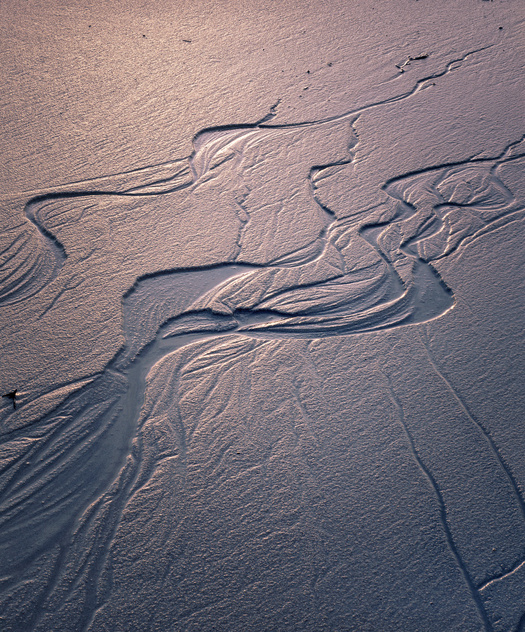
On the very last day of our large format course we went over to Budle Bay to take a look at the sand patterns (and possibly take the odd photo). While Joe and a few others went over to the see pools created as the tide went out, myself and Paul Arthur went up into the dunes to try to capture some of the shifting sands. The main pictures are of an old peat layer that is gradually being revealed by the erosion. I went back to this location a few months later and the whole structure of the area had changed. That evening also saw a wonderful sunset - that I spent taking stupid pictures of the water. However I did get a nice picture of the sand patterns which were unlike any I had seen before (it reminded me of snake skin).

I really enjoyed the large format course and it felt like learning from friends rather than being tutored. I highly recommend the Light and Land large format courses, both Joe and David have an enormous amount of experience and you couldn't have a better starting point for a journey into large format than this.

Out of interest, I'd be interested in knowing which of the pictures in the sidebar you think I should include in my main gallery? I'll say which I prefer after I've got one or two comments..

Thanks for reading and sorry for the slow posting - I'm getting back into regular swing of things now and promise to post once a week from now on.

system asset

system asset

[125 items]
1